What was the last country to challenge the United Statess control of Oregon?
| Oregon Country Oregon Country | |||||||||||||||||||
|---|---|---|---|---|---|---|---|---|---|---|---|---|---|---|---|---|---|---|---|
| 1818–1846 | |||||||||||||||||||
| American and Hudson'southward Bay Company flags were used. | |||||||||||||||||||
 | |||||||||||||||||||
| Capital letter | Oregon City (Usa) Fort St. James (British) | ||||||||||||||||||
| Leaders | |||||||||||||||||||
| • (British; 1818-1822) | Governor Joseph Berens of Hudson'southward Bay Company | ||||||||||||||||||
| • (British; 1822-1846) | Governor John Pelly of Hudson'due south Bay Company | ||||||||||||||||||
| • (U.s.; 1841-1843) | Supreme Judge Ira Babcock | ||||||||||||||||||
| • (U.s.; 1843-1845) | Executive Committee | ||||||||||||||||||
| • (US; 1845-1846) | Governor George Abernethy | ||||||||||||||||||
| History | |||||||||||||||||||
| • Established | Oct xx 1818 | ||||||||||||||||||
| • Due north West Company merges with Hudson's Bay Visitor | July, 1821 | ||||||||||||||||||
| • Fort Vancouver built | 1824 | ||||||||||||||||||
| • Oregon City congenital | 1829 | ||||||||||||||||||
| • United states of america Constitutional Committee | February eighteen, 1841 | ||||||||||||||||||
| • Usa Provisional Government | May 2, 1843 | ||||||||||||||||||
| • Organic Laws of Oregon | July 5, 1843 | ||||||||||||||||||
| • George Abernethy becomes Governor | June 3, 1845 | ||||||||||||||||||
| • Oregon Treaty | June fifteen, 1846 | ||||||||||||||||||
| Currency | Beaver pare | ||||||||||||||||||
| |||||||||||||||||||


Oregon Country was a disputed region of the Pacific Northwest of North America in the 19th century. The region was occupied by British and French Canadian fur traders from earlier 1810, likewise as American settlers from the mid-1830s, with its coastal areas north from the Columbia River frequented past ships from all nations engaged in the maritime fur merchandise, almost of these from the 1790s through 1810s beingness Boston-based. The Oregon Treaty of 1846 ended disputed joint occupancy pursuant to the Treaty of 1818 and established the British-American purlieus at the 49th parallel (except Vancouver Isle).[1]
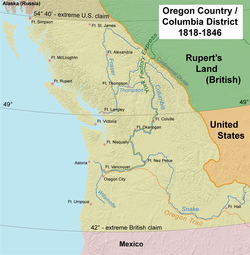
Oregon was a distinctly American term for the region. The British used the term Columbia District instead.[2] The Oregon Land consisted of the land north of 42°North latitude, s of 54°twoscore′N latitude, and west of the Rocky Mountains—with the eastern border generally running on or close to the Continental Divide—westwards to the Pacific Ocean. The expanse now forms role of the present mean solar day Canadian province of British Columbia and all of the U.S. states of Oregon, Washington, and Idaho, besides as parts of Montana and Wyoming. The British presence in the region was more often than not administered by the Hudson's Bay Company, whose Columbia Section comprised most of the Oregon Land and extended considerably north into New Caledonia and beyond 54°40′N, with operations reaching tributaries of the Yukon River.[3]
Etymology [edit]
The primeval evidence of the name "Oregon" has Spanish origins. The term "orejón" comes from the historical chronicle Relación de la Alta y Baja California (1598)[4] which was written by the New Spaniard Rodrigo Motezuma and which made reference to the Columbia River when the Spanish explorers penetrated into the North American territory that became function of the Viceroyalty of New Espana. This chronicle is the first topographical and linguistic source with respect to the place name "Oregon". At that place are as well two other sources with Spanish origins such as the proper name Oregano which grows in the southern function of the region. Information technology is most probable that the American territory was named by the Spaniards equally there are some populations in Spain such as "Arroyo del Oregón" which is situated in the province of Ciudad Real, also considering that the individualization in Spanish linguistic communication "El Orejón" with the mutation of the letter "grand" instead of "j".[5]
Another theory is that French Canadian fur company employees called the Columbia River "hurricane river" le fleuve d'ouragan, because of the stiff winds of the Columbia Gorge. George R. Stewart argues in a 1944 article in American Spoken communication that the name came from an engraver's error in a French map published in the early on 18th century, on which the Ouisiconsink (Wisconsin River) was spelled "Ouaricon-sint", broken on ii lines with the -sint beneath, so that there appeared to be a river flowing to the due west named "Ouaricon".[6] [seven] This theory was endorsed in Oregon Geographic Names every bit "the nigh plausible caption".[eight]
Early exploration [edit]
George Vancouver explored Puget Sound in 1792. Vancouver claimed it for Uk on 4 June 1792, naming it for one of his officers, Lieutenant Peter Puget. Alexander Mackenzie was the first European to cross Due north America by land north of New Spain,[9] arriving at Bella Coola on what is now the central coast of British Columbia in 1793. From 1805 to 1806 Meriwether Lewis and William Clark explored the territory for the United States on the Lewis and Clark Trek.
David Thompson, working for the Montreal-based Due north West Company, explored much of the region beginning in 1807, with his friend and colleague Simon Fraser following the Fraser River to its mouth in 1808, attempting to ascertain whether information technology was the Columbia, as had been theorized about it in its northern reaches through New Caledonia, where information technology was known by its Dakleh name equally the "Tacoutche Tesse". Thompson was the get-go European to voyage down the unabridged length of Columbia River. Along the style, his party camped at the junction with the Snake River on nine July 1811. He erected a pole and a notice claiming the country for the United Kingdom and stating the intention of the North West Company to build a trading mail service on the site. Later in 1811, on the aforementioned expedition, he finished his survey of the entire Columbia, arriving at a partially synthetic Fort Astoria two months subsequently the departure of John Jacob Astor's ill-fated Tonquin.[10]
Territorial evolution [edit]
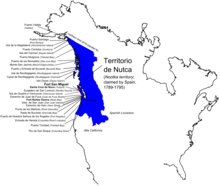
Spanish territorial claims on the W Coast of North America in the 18th century
The Oregon Country was originally claimed by Swell United kingdom of great britain and northern ireland, French republic, Russia, and Spain; the Spanish claim was later taken up by the United States. The extent of the region being claimed was vague at offset, evolving over decades into the specific borders specified in the U.Southward.-British treaty of 1818. The U.Southward. based its claim in part on Robert Gray'due south entry of the Columbia River in 1792 and the Lewis and Clark Expedition. Swell Great britain based its claim in part on British overland explorations of the Columbia River past David Thompson and on prior discovery and exploration along the coast. Spain's claim was based on the Inter caetera and Treaty of Tordesillas of 1493–94, likewise every bit explorations of the Pacific declension in the late 18th century.[11] Russia based its claim on its explorations and trading activities in the region and asserted its buying of the region north of the 51st parallel by the Ukase of 1821, which was speedily challenged by the other powers and withdrawn to 54°twoscore′N by carve up treaties with the U.S. and United kingdom of great britain and northern ireland in 1824 and 1825 respectively.[12]
Spain gave up its claims of exclusivity via the Nootka Conventions of the 1790s. In the Nootka Conventions, which followed the Nootka Crisis, Spain granted U.k. rights to the Pacific Northwest, although it did not found a northern boundary for Castilian California, nor did it extinguish Spanish rights to the Pacific Northwest.[13] Spain later on relinquished whatsoever remaining claims to territory north of the 42nd parallel to the United States equally role of the Adams-Onís Treaty of 1819. In the 1820s, Russia gave upwards its claims south of 54°40′ and east of the 141st meridian in separate treaties with the Us and Britain.[14]
Meanwhile, the United states of america and Great britain negotiated the Anglo-American Convention of 1818 that extended the purlieus between their territories due west along the 49th parallel to the Rocky Mountains. The two countries agreed to "articulation occupancy" of the country due west of the Rockies to the Pacific Ocean.[15]
In 1843, settlers established their ain government, called the Provisional Government of Oregon. A legislative committee drafted a lawmaking of laws known as the Organic Law. It included the creation of an executive commission of iii, a judiciary, militia, country laws, and four counties. There was vagueness and confusion over the nature of the 1843 Organic Law, in particular whether it was constitutional or statutory. In 1844, a new legislative commission decided to consider information technology statutory. The 1845 Organic Law made additional changes, including allowing the participation of British subjects in the government. Although the Oregon Treaty of 1846 settled the boundaries of U.S. jurisdiction, the provisional authorities continued to part until 1849, when the kickoff governor of Oregon Territory arrived.[16] A faction of Oregon politicians hoped to continue Oregon'due south political evolution into an contained nation, merely the pressure to join the Us would prevail past 1848, iv months afterwards the Mexican–American War.[17]
Early settlement [edit]


Map of Columbia and its tributaries showing modern political boundaries. In 1811 David Thompson navigated the unabridged length of Columbia River

Map of the road of the York Manufactory Express, 1820s to 1840s, with mod political boundaries shown
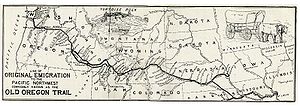
The Oregon trail started in St. Louis, Missouri.
In 1805, the American Lewis and Clark Expedition marked the first official American exploration of the expanse, creating the first temporary settlement of Euro-Americans in the area near the mouth of the Columbia River at Fort Clatsop. Two years later in 1807, David Thompson of the British-endemic North West Company penetrated the Oregon Country from the north, via Athabasca Pass, near the headwaters of the Columbia River. From at that place he navigated nearly the total length of the river through to the Pacific Ocean.
In 1810, John Jacob Astor commissioned and began the structure of the American Pacific Fur Company fur-trading mail at Fort Astoria merely five miles from the site of Lewis and Clark's former Fort Clatsop, completing construction of the first permanent Euro-American settlement in the area in 1811. This settlement subsequently served equally the nucleus of present day Astoria, Oregon. During the menses of the construction of Fort Astoria, Thompson traveled down the Columbia River, noting the partially constructed American Fort Astoria but two months afterwards the deviation of the supply transport Tonquin.
Along the mode, Thompson had gear up pes on and claimed for the British Crown, the lands in the vicinity of the future Fort Nez Perces site at the confluence of the Columbia and Serpent rivers. This claim initiated a very brief era of competition between American and British fur traders. During the War of 1812, Fort Astoria was captured past the British and sold to the North West Company. Nether British control, Fort Astoria was renamed Fort George.[18]
In 1821 when the Northward W Company was merged with the Hudson's Bay Company, the British Parliament moved to impose the laws of Upper Canada upon British subjects in Columbia District and Rupert's State, and issued the say-so to enforce those laws to the Hudson's Bay Company. Chief Gene John McLoughlin was appointed manager of the district'southward operations in 1824. He moved the regional company headquarters to Fort Vancouver (mod Vancouver, Washington) in 1824. Fort Vancouver became the center of a thriving colony of mixed origin, including Scottish Canadians and Scots, English, French Canadians, Hawaiians, Algonkians, and Iroquois, every bit well as the offspring of visitor employees who had intermarried with various local native populations.
Astor connected to compete for Oregon State furs through his American Fur Company operations in the Rockies.[19] In the 1820s, a few American explorers and traders visited this land beyond the Rocky Mountains. Long after the Lewis and Clark Trek and also later the consolidation of the fur trade in the region past the Canadian fur companies, American mountain men such every bit Jedediah Smith and Jim Beckwourth came roaming into and across the Rocky Mountains, following Indian trails through the Rockies to California and Oregon. They sought beaver pelts and other furs, which were obtained by trapping. These were difficult to obtain in the Oregon Country considering of the Hudson'southward Bay Company policy of creating a "fur desert": deliberate over-hunting of the expanse's frontiers, so that American trades would find nothing there.[20] The mountain men, like the Metis employees of the Canadian fur companies, adopted Indian ways, and many of them married Native American women.[21]
Reports of Oregon State somewhen circulated in the eastern United States. Some churches decided to ship missionaries to convert the Indians. Jason Lee, a Methodist minister from New York, was the first Oregon missionary. He built a mission school for Indians in the Willamette Valley in 1834. American settlers began to make it from the east via the Oregon Trail starting in the early 1840s and came in increasing numbers each subsequent yr. Increased tension led to the Oregon boundary dispute. Both sides realized that settlers would ultimately make up one's mind who controlled the region. The Hudson'due south Bay Company, which had previously discouraged settlement as information technology conflicted with the lucrative fur trade, tardily reversed their position. In 1841, on orders from Sir George Simpson, James Sinclair guided more than 100 settlers from the Cherry River Colony to settle on HBC farms well-nigh Fort Vancouver. The Sinclair expedition crossed the Rockies into the Columbia Valley, near present-day Radium Hot Springs, British Columbia, then traveled southwest downwardly the Kootenai River and Columbia River following the southern portion of the well established York Factory Express trade route.[22]
The Canadian effort proved to exist also picayune, too late. In what was dubbed "The Great Migration of 1843" or the "Wagon Train of 1843", an estimated 700 to 1,000 American emigrants came to Oregon, decisively tipping the balance.[23] [24]
Oregon Treaty [edit]

Mural on the walls of the Oregon Capitol Building depicting the provisional government seal
In 1843, settlers in the Willamette Valley established a conditional government at Champoeg. Political pressure level in the United states urged the occupation of all the Oregon Land. Expansionists in the American Due south wanted to annex Texas, while their counterparts in the northeast wanted to annex the Oregon Country. It was seen as significant that the expansions be parallel, as the relative proximity to other states and territories fabricated it appear likely that Texas would be pro-slavery and Oregon against slavery.[ commendation needed ]
In the 1844 U.Due south. Presidential election, the Democrats had chosen for expansion into both areas. Subsequently his election as president, even so, James Thou. Polk supported the 49th parallel as a northern limit for U.Southward. annexation in Oregon Country. Information technology was Polk'southward uncompromising back up for expansion into Texas and relative silence on the Oregon boundary dispute that led to the phrase "Fifty-Four Forty or Fight!", referring to the northern edge of the region and often erroneously attributed to Polk's campaign. The goal of the slogan was to rally Southern expansionists (some of whom wanted to annex but Texas in an effort to tip the remainder of slave/gratis states and territories in favor of slavery) to support the effort to annex Oregon Country, highly-seasoned to the popular conventionalities in manifest destiny. The British government, meanwhile, sought control of all territory n of the Columbia River.[25]
Despite the posturing, neither land really wanted to fight what would have been the third war in 70 years against the other. The two countries eventually came to a peaceful agreement in the 1846 Oregon Treaty that divided the territory west of the Continental Divide forth the 49th parallel to Georgia Strait; with all of Vancouver Isle remaining under British control. This border today divides British Columbia from neighboring Washington, Idaho, and Montana.
Hudson's Bay Company [edit]
In 1843 the HBC shifted its Columbia Section headquarters from Fort Vancouver to Fort Victoria on Vancouver Island. The programme to move to more than northern locations dated back to the 1820s. George Simpson was the main strength behind the move north; John McLoughlin became the primary hindrance. McLoughlin had devoted his life's work to the Columbia business, and his personal interests were increasingly linked to the growing settlements in the Willamette Valley. He fought Simpson'south proposals to motility north in vain. Past the time Simpson made the final decision in 1842 to motility the headquarters to Vancouver Isle, he had had many reasons for doing so. There was a dramatic decline in the fur merchandise across North America. In contrast the HBC was seeing increasing profits with coastal exports of salmon and lumber to Pacific markets such equally Hawaii. Coal deposits on Vancouver Isle had been discovered, and steamships such as the Beaver had shown the growing value of coal, economically and strategically. A general HBC shift toward Pacific shipping and away from the interior of the continent made Victoria Harbour much more suitable than Fort Vancouver's location on the Columbia River. The Columbia Bar at the river'due south mouth was unsafe and routinely meant weeks or months of waiting for ships to cross. The largest ships could not enter the river at all. The growing numbers of American settlers forth the lower Columbia gave Simpson reason to question the long term security of Fort Vancouver. He worried, rightfully so, that the final border resolution would not follow the Columbia River. By 1842, he idea it more likely that the U.S. would at least need Puget Sound, and the British government would take a border every bit far north as the 49th parallel, excluding Vancouver Island. Despite McLoughlin's stalling, the HBC had begun the process of shifting abroad from Fort Vancouver and toward Vancouver Island and the northern declension in the 1830s. The increasing number of American settlers arriving in the Willamette Valley after 1840 served to make the need more pressing.[26]
Oregon Territory [edit]
In 1848, the U.Southward. portion of the Oregon Country was formally organized as the Oregon Territory. In 1849, Vancouver Island became a British Crown colony—the Colony of Vancouver Isle—with the mainland being organized into the Colony of British Columbia in 1858. Shortly after the establishment of Oregon Territory, in that location was an effort to carve up off the region north of the Columbia River. As a event of the Monticello Convention, Congress approved the cosmos of Washington Territory in early 1853. President Millard Fillmore canonical the new territory on 2 March 1853.[27]
Descriptions of the land and settlers [edit]
Alexander Ross, an early Scottish Canadian fur trader, describes the lower Columbia River area of the Oregon State (known to him as the Columbia District):
The banks of the river throughout are low and skirted in the distance by a chain of moderately high lands on each side, interspersed here and at that place with clumps of wide spreading oaks, groves of pine, and a diversity of other kinds of woods. Betwixt these high lands lie what is called the valley of the Wallamitte [sic], the frequented haunts of innumerable herds of elk and deer ... In ascending the river the surrounding country is well-nigh delightful, and the offset bulwark to be run into with is nearly 40 miles up from its mouth. Here the navigation is interrupted by a ledge of rocks, running across the river from side to side in the grade of an irregular horseshoe, over which the whole body of water falls at one leap down a precipice of about forty feet, called the Falls.
After living in Oregon from 1843 to 1848, Peter H. Burnett wrote:
[Oregonians] were all honest, considering in that location was zippo to steal; they were all sober, because there was no liquor to drink; at that place were no misers, because at that place was no coin to hoard; and they were all industrious, because information technology was work or starve.[28] [29]
See also [edit]
- American borderland
- Bibliography of Oregon history
- Canada–United States edge
- American Imperialism
- Cascadia (independence movement), a contemporary movement to make the Cascadian bioregion, roughly covering the same surface area as the Oregon state, an independent country
- New Albion
- Robert Grey's Columbia River expedition
- Royal Announcement of 1763 – some other British-border treaty dependent on one or more hydrology divides to make up one's mind at least one of its borders
- Russo-American Treaty of 1824
- Treaty of Saint Petersburg (1825)
References [edit]
- ^ "United kingdom of great britain and northern ireland and the United States agree on the 49th parallel as the main Pacific Northwest boundary in the Treaty of Oregon on June 15, 1846". History Link. thirteen July 2013. Retrieved v Apr 2021.
{{cite web}}: CS1 maint: url-status (link) - ^ Meinig, D.Due west. (1995) [1968]. The Keen Columbia Patently (Weyerhaeuser Environmental Classic ed.). Academy of Washington Press. p. 104. ISBN0-295-97485-0.
- ^ Mackie, Richard Somerset (1997). Trading Beyond the Mountains: The British Fur Trade on the Pacific 1793–1843. Vancouver: Academy of British Columbia (UBC) Press. p. 284. ISBN0-7748-0613-three.
- ^ Motezuma, Rodrigo (2002). La isla de oro: relación de la alta y Baja California (1. ed.). Valladolid: Universitas Castellae. ISBN84-92315-67-ix.
- ^ Fernández-Shaw, Carlos One thousand. (1987). Presencia española en los Estados Unidos (2a ed. aum. y corr. ed.). Madrid: Instituto de Cooperación Iberoamericana, Ediciones Cultura Hispánica. ISBN84-7232-412-five.
- ^ Stewart, George R. (1944). "The Source of the Name 'Oregon'". American Speech. Duke Academy Printing. 19 (two): 115–117. doi:10.2307/487012. JSTOR 487012.
- ^ Stewart, George R. (1967) [1945]. Names on the State: A Historical Account of Place-Naming in the United States (Sentry edition (tertiary) ed.). Houghton Mifflin. pp. 153, 463.
- ^ McArthur, Lewis A.; Lewis 50. McArthur (2003) [1928]. Oregon Geographic Names (Seventh ed.). Portland, Oregon: Oregon Historical Club Press. ISBN0-87595-277-1.
- ^ DeVoto, Bernard (1953). The Journals of Lewis and Clark. Houghton Mifflin Company. p. xxix. ISBN0-395-08380-X.
- ^ Nisbet, Jack (1994). Sources of the River: Tracking David Thompson Across Western Northward America. Sasquatch Books. pp. 4–v. ISBNi-57061-522-5.
- ^ Elliott, John Huxtable (2007). Empires of the Atlantic World. Yale Academy Press. pp. eleven–12. ISBN978-0-300-12399-9. online at Net Archive
- ^ Haycox, Stephen W. (2002). Alaska: An American Colony. Academy of Washington Press. pp. 1118–1122. ISBN978-0-295-98249-6.
- ^ Weber, David J. (1994). The Spanish Frontier in North America. Yale University Press. p. 287. ISBN978-0-300-05917-five. online at Google Books
- ^ Chiorazzi, Michael 1000.; Marguerite Nigh (2005). Prestatehood Legal Materials. Haworth Press. p. 959. ISBN978-0-7890-2056-7. online at Google Books
- ^ "Convention of Commerce between His Majesty and the The states of America.--Signed at London, 20th Oct, 1818". Archived from the original on 2009-04-xi.
- ^ Chiorazzi, Michael G.; Marguerite Most (2005). Prestatehood Legal Materials. Haworth Press. pp. 959–962. ISBN978-0-7890-2056-7. online at Google Books
- ^ Clarke, S.A. (1905). Pioneer Days of Oregon History. J.Thou. Gill Company.
- ^ Meinig, D.Westward. (1995) [1968]. The Great Columbia Patently (Weyerhaeuser Environmental Archetype ed.). University of Washington Press. p. 52. ISBN0-295-97485-0.
- ^ Mackie, Richard Somerset (1997). Trading Beyond the Mountains: The British Fur Trade on the Pacific 1793–1843. Vancouver: University of British Columbia (UBC) Press. pp. 65, 108, 110–111. ISBN0-7748-0613-3.
- ^ Mackie, Richard Somerset (1997). Trading Beyond the Mountains: The British Fur Merchandise on the Pacific 1793–1843. Vancouver: University of British Columbia (UBC) Press. pp. 64–65, 259. ISBN0-7748-0613-3.
- ^ White, Bruce Yard. (Winter 1999). "The Woman Who Married a Beaver: Merchandise Patterns and Gender Roles in the Ojibwe Fur Trade". Ethnohistory. Thousand Marais, Minnesota. 46 (1): 109–147.
- ^ Galbraith, John South. (1954), "The Early History of the Puget's Audio Agricultural Company, 1838-43", Oregon Historical Quarterly, Portland, OR: Oregon Historical Society, 55 (3): 234–259.
- ^ "The Railroad vehicle Train of 1843: The Great Migration. Oregon Pioneers". Archived from the original on 2008-05-31. Retrieved 2016-02-06 . .
- ^ "The Westward Film Project (2001) - Events in The West: 1840–1850". pbs.org. PBS. 2001. Retrieved 2021-03-16 .
- ^ "Oregon Question". www.oregonencyclopedia.org . Retrieved 2021-08-12 .
- ^ Mackie, Richard Somerset (1997). Trading Beyond the Mountains: The British Fur Trade on the Pacific 1793–1843. Vancouver: University of British Columbia (UBC) Press. pp. 240–245, 256–262, 264–273, 276. ISBN0-7748-0613-3. online at Google Books
- ^ Weber, Dennis P. (2003). "The Creation of Washington: Securing Commonwealth Due north of the Columbia" (PDF). Columbia – the Magazine of Northwest History. 17 (three). Retrieved 9 September 2019.
- ^ MacColl, E. Kimbark (1979). The Growth of a Metropolis: Power and Politics in Portland, Oregon 1915–1950. Portland, Oregon: The Georgian Press. ISBN0-9603408-ane-5.
- ^ MacColl cites Peter H. Burnett, Recollections and Opinions of an Former Pioneer, New York 1880, p.181.
Bibliography [edit]
- Richard W. Etulain, Lincoln and Oregon Country Politics in the Civil War. Corvallis, OR: Oregon State University Press, 2013.
External links [edit]
- Chronology of Oregon Events
- Convention Betwixt Keen Britain and Russian federation, 1825 (Treaty of Petrograd, 1825)
Coordinates: 48°Due north 122°Due west / 48°N 122°Due west / 48; -122
Source: https://en.wikipedia.org/wiki/Oregon_Country
0 Response to "What was the last country to challenge the United Statess control of Oregon?"
Post a Comment