what term means to pass a law over the presidents veto
Presidential vetoes: How they work, who issued the most and how Congress stops them
President Trump is preparing to issue his first veto subsequently Congress voted toreject his national emergency declaration along the southern border. So far, Mr. Trump has been ane of the nigh restrained presidents in modern history when information technology comes to veto power.
Mr. Trump is right now the only president in nearly 140 years with no vetoes to his name. He is also among the few in the by 40 years to become this far into his presidency without ane. Presidents Barack Obama, George H.West. Bush-league and Ronald Reagan all had vetoes within their first year in office.
It was once mutual for presidents to deliver dozens of vetoes, and for Congress to overturn a few of them. Some presidents racked upwardly hundreds. But presidential vetoes and congressional overrides have been steadily dropping for decades.
With Democrats at present in control of the House after two years of Republicans controlling Congress, Mr. Trump could begin breaking out his veto pen more often.
Here's what yous need to know about the president's veto powers:
How practise vetoes and veto overrides piece of work?
Article I of the Constitution grants the president authorisation to pass up legislation passed by Congress in two ways: a "regular veto" and a "pocket veto."
Later Congress passes a nib, the president has 10 days (excluding Sundays) to review the legislation. He can sign the bill and send it back to Congress, at which indicate information technology becomes constabulary. He can also do cipher, and if Congress is in session after ten days, the bill becomes constabulary automatically.
In a regular veto, the president rejects the nib by sending it dorsum to Congress without his signature. Congress can then attempt to override the veto, which requires a two-thirds vote in the House and Senate. If an override vote is successful, the legislation becomes law over the president's objection.
A pocket veto can't be overridden. The Constitution's 10-day window to review legislation includes an exception if Congress is adjourned at the deadline. With a pocket veto, the president simply doesn't sign the neb, and doesn't return it to Congress, meaning it doesn't get police force. Lawmakers must and so have up the legislation once they reconvene and either hope that the president approves a revision, or that his next veto tin exist overridden.
Presidents are more likely to veto bills when at least one sleeping room of Congress is controlled by the other political party, according to information from the American Presidency Project and the University of California, Santa Barbara. For example, President Barack Obama issued just two vetoes in his first ii years, when Democrats held majorities in the House and Senate. In his concluding ii years, with Republicans controlling both chambers, he issued 10.
Which president issued the most vetoes?
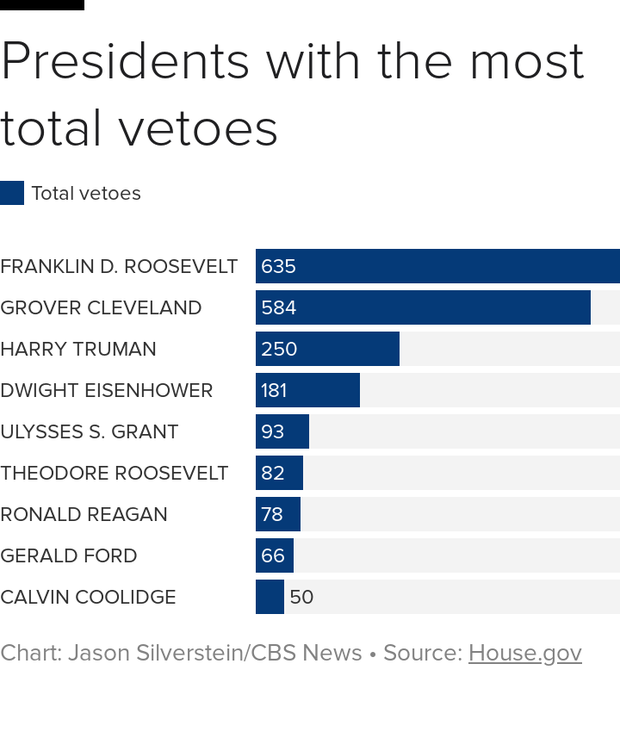
President Franklin D. Roosevelt, a Democrat, has more vetoes to his name than the majority of other presidents combined. According to Senate records, Roosevelt handed down a full of 635 vetoes — 372 regular, 263 pocket — during his 12 years in office. Those vetoes stretched across a broad swath of issues, including country rights, military pensions, federal budgeting, fertilizer regulation and whether retailers in Washington, D.C., could purchase beer on credit.
Ironically, FDR had Autonomous majorities in the Senate and House through all iv of his terms.
Merely three other presidents had vetoes in the hundreds:
- Grover Cleveland: 584 full; 346 regular, 238 pocket
- Harry Truman: 250 total; 180 regular, 70 pocket
- Dwight D. Eisenhower: 181 total; 73 regular, 108 pocket
The last president to come close to 100 was Ronald Reagan, who had 78 vetoes across his two terms. The number of vetoes has dropped for every president since then: George W. Bush and Obama each delivered just 12.
The final president to issue zilch vetoes was James Garfield, who was president for less than vii months before his death in 1881. John Adams, Thomas Jefferson, John Quincy Adams, William Henry Harrison and MIllard Fillmore also issued cipher, according to the American Presidency Projection's database.
Which president did Congress override the most?
It's rare for Congress to override a presidential veto. Presidents accept vetoed two,574 bills in U.S. history, according to House records. Out of those, Congress overrode only 111.
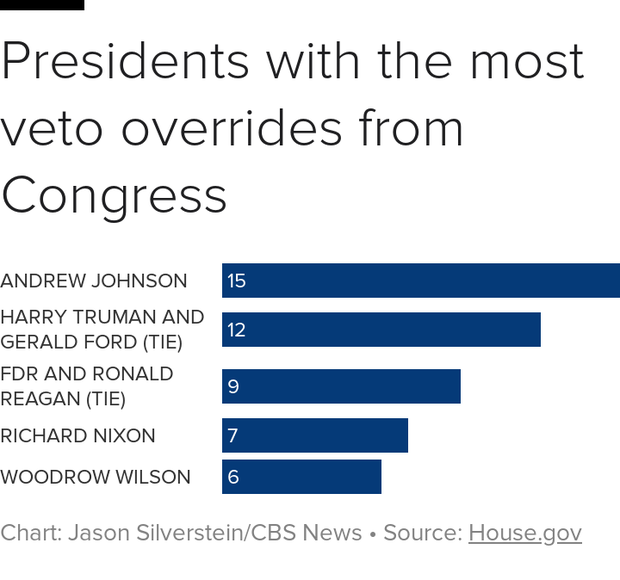
President Andrew Johnson — the starting time president to be impeached — faced the nearly opposition from Congress. He issued 29 full vetoes, and Congress overrode 15 of them.
Behind him, Truman and Gerald Ford are tied for 2nd, both with 12 overrides each. The resistance to Ford is notable because he was only in function for a lilliputian over two years.
Every other president has faced fewer than x overrides, no matter how many times they vetoed. FDR, the all-time record-holder, saw only nine of his 635 vetoes defeated in Congress, including the first acquirement police force passed without the president's approval.
Cheers for reading CBS NEWS.
Create your gratis account or log in
for more features.
Source: https://www.cbsnews.com/news/presidential-vetoes-how-they-work-who-had-the-most-and-how-congress-stops-them/
0 Response to "what term means to pass a law over the presidents veto"
Post a Comment